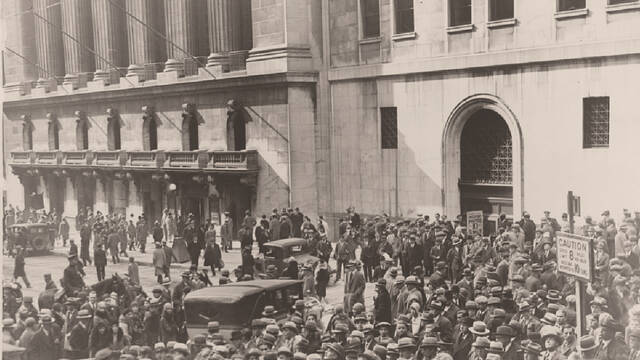
In his recent book 1929: The Year of the Great Crash and the Downfall of the American Dream, Andrew Ross Sorkin turns his attention from the modern financial crises he chronicled in Too Big to Fail to the quintessential benchmark of American market history: the stock market crash of 1929 and the devastating economic collapse that followed.
Like Too Big to Fail, Sorkin’s perspective as a financial historian is told through the eyes of the people of that time rather than abstractions, which brings those black-and-white images we’re so familiar with to life. In 1929, Sorkin brings readers inside boardrooms, New York City brokerage houses, and Washington DC offices, revealing how optimism, leverage, policy errors, and human psychology combined to result in a substantial market decline that devolved into the Great Depression. We hear the perspective of Charles Mitchell (president of one of the largest banks at the time), Jesse Livermore (famed market speculator), Thomas Lamont (partner at JP Morgan), President Herbert Hoover, and Senator Carter Glass. The book is not merely a history lesson—it is a study in how fragile financial systems can become when psychology trumps discipline both on the way up and on the way down.
For investors today, the natural question is not academic: could something like 1929 happen again? And just as importantly, what should a thoughtful wealth plan look like if markets do experience another severe downturn?
The short answer is that while markets will always experience cycles of fear and excess, today’s financial system is fundamentally different from the one that failed in 1929. Those differences, many born directly out of the Great Depression, matter enormously for today’s long-term investors. Though the laws on disclosure and limits on speculation and government-backed shock absorbers are different today, fundamental human nature is not.
The Speculative Engine of 1929: Margin Debt Run Amok
One of the most striking elements Sorkin highlights is the scale of speculation leading up to the crash, particularly margin buying. In the late 1920s, investors routinely borrowed from banks and brokers to buy stocks, often putting down as little as 10% of the purchase price. Leverage is like fire; it has many critical uses, but can burn your house down when mishandled.
By September 1929, broker loans, money borrowed to buy stocks, had reached approximately $8.5 billion, a staggering figure at the time. That amount represented more than 12% of total U.S. stock market capitalization, exceeded the entire annual federal budget, and was estimated to be between 6-8% of US GDP at the time. In practical terms, this meant a huge portion of the stock market pricing was supported not by savings or earnings power, but by borrowed money.
Valuations in 1929 were less clear, but there were many high-flyers trading at nosebleed valuations, some in excess of 70x earnings. These were the .com or AI stocks at the time and included RCA (Radio Corporation of America), Anaconda Copper, General Motors, and Sears and Roebuck. From peak-to-trough, many of these companies endured 90%+ drawdowns.
This leverage worked beautifully on the way up. However, when prices began to slip, margin calls forced investors to sell, regardless of price. This created a “rush to the exits” and a vicious feedback loop. Selling begat more selling, and what might have been a sharp correction turned into a collapse. This dynamic—excess leverage paired with collapsing confidence—is a recurring theme in financial crises. It also explains why so many of the reforms that followed focused on reducing systemic risk and restoring trust.
What’s Different Today—and Why It Matters
While human behavior hasn’t changed much in a century, the structure of the financial system has changed. Three developments help explain why a 1929-style collapse is far less likely today.
1. Structural Safeguards: Glass-Steagall and FDIC Insurance
In 1929, commercial banks freely mixed traditional lending with speculative investment activities. Depositors’ money could be, and often was, used to fund stock market speculation. When markets collapsed, banks failed en masse, and ordinary savers lost everything.
Two landmark reforms changed this:
- The Glass-Steagall Act (1933): This legislation separated commercial banking from investment banking, sharply reducing conflicts of interest and limiting the ability of banks to speculate with depositor funds. Although parts of Glass-Steagall were repealed decades later (1999), its core philosophy still informs today’s regulatory environment, including the Volcker Rule (part of the Dodd-Frank Act (2010)), which restricts proprietary trading by banks.
- FDIC Insurance (1933): The creation of the Federal Deposit Insurance Corporation was perhaps the most powerful stabilizing force ever introduced into the financial system. By insuring bank deposits—today up to $250,000 per depositor, per institution—the FDIC virtually eliminated the classic bank runs that plagued the early 1930s and resulted in thousands of bank failures, wiping out many nest eggs or ordinary savers. Confidence, once lost, is hard to restore, but FDIC insurance helped rebuild it.
2. Policy Mistakes That Made Things Worse
Not all responses to the crash were helpful. One of the most damaging was the Smoot-Hawley Tariff Act of 1930. Designed to protect American jobs and industries, Smoot-Hawley raised tariffs on more than 20,000 imported goods. The unintended consequences were severe as trading partners retaliated with tariffs of their own, and global trade volumes collapsed by nearly 50% between 1929 and 1933.
Rather than insulating the economy, protectionism amplified the downturn. Smoot-Hawley stands as a cautionary tale of how well-intended but reactionary policy can compound financial stress. While the same disadvantage of tariffs remains today, the recent tariffs are much more surgical, and the smaller scale compared to the blunt force approach of those in 1930.
3. Today’s Modern Financial System with a Proven Crisis Playbook
In 1929, the Federal Reserve was young, cautious, and reluctant to intervene. It failed to provide liquidity when the system needed it most. Credit dried up, banks failed, and the economy spiraled downward. The Federal Reserve did not aggressively cut rates after the crash despite raising them prior to 1929 to curb speculation. By the mid-1930’s, the Fed raised rates to defend US gold reserves (the US dollar was still on the gold standard).
Today’s Federal Reserve operates with vastly expanded tools and a clear mandate to stabilize financial markets. We saw this occur twice in recent history:
- The 2008 financial crisis, when the Fed acted as lender of last resort
- The COVID shock of 2020, when emergency facilities were deployed in days, not months
Coupled with mandatory financial disclosures, stress testing for banks, capital requirements, and market circuit breakers, it becomes clear that today’s system is built to absorb shocks rather than amplify them.
Finally, Regulation T from the Federal Reserve restricts margin buying at a much more stringent level today. Only, up to, 50% can be borrowed against “margin eligible” stocks (typically high quality, liquid equities). With bonds usually less volatile, more can typically be borrowed against their value. In addition, FINRA requires at least 25% equity in a margin account with many brokers requiring even higher amounts.
What This Means for Your Wealth Plan
History never gives us a precise script for the future, but it does offer guidance. The lesson of 1929 is not that markets should be feared; it’s that fragility comes from concentration, leverage, and poor planning.
So, what to do? Prepare for and expect large market downturns instead of trying to predict them.
1. Thoughtful, Global Diversification
Diversification remains the most reliable risk management tool available. A resilient portfolio typically includes:
- Both U.S. and international equities
- High-quality fixed income
- Select real assets or alternatives where appropriate
- Adequate liquidity for flexibility
Equally important is avoiding excessive concentration in any single stock, sector, or employer, especially when those positions are tied to personal income.
2. A Disciplined and Liquid Retirement Income Structure
For retirees and those nearing retirement, downturns are most dangerous when cash flow depends on selling assets at depressed prices. A structured “portfolio paycheck” approach—holding cash and short-term bonds to fund near-term spending—can dramatically reduce this risk and improve peace of mind. If 1929 taught us anything, it’s that liquidity is king in times of economic and market distress, and having at least two years’ worth of stable funds has enormous value.
3. Tax Planning as an Active Strategy & Shock Absorber
Market declines often create opportunities for proactive tax planning, including:
- Harvesting losses
- Executing Roth conversions at lower valuations
- Rebalancing in a tax-efficient way
These strategies don’t eliminate volatility, but they can meaningfully improve long-term after-tax outcomes when the recovery eventually ensues.
4. Behavioral Discipline Over Market Timing
If 1929 teaches us anything, it’s that the greatest damage is often self-inflicted. Panic selling, overconfidence during booms, and reactionary decisions destroy more wealth than bear markets themselves. A written plan, systematic rebalancing, and objective advice help keep emotions from overriding logic when markets are most stressful.
Bottom Line
Andrew Ross Sorkin’s 1929 is a powerful reminder that financial crises are never just about numbers, they’re about human nature, leverage, and policy choices. While another Great Depression is highly unlikely, meaningful market downturns are inevitable. The good news is the investment and banking environment today is far better equipped than those of 1929. For investors with diversified portfolios, structural safeguards, disciplined planning, and thoughtful tax strategies, market volatility becomes something to manage and not fear.
As the old saying goes, history doesn’t repeat, but it does rhyme. The goal isn’t to avoid the next unavoidable and impossible-to-predict downturn. It’s to ensure your wealth plan is built to endure it.
Published 02/17/2026
This material is provided for informational and educational purposes only and should not be construed as individualized investment advice, tax advice, legal advice, or a recommendation to engage in any specific investment strategy. The information contained herein may not be suitable for all investors and does not take into account your particular investment objectives, financial situation, or risk tolerance. You should not make any financial, investment, or tax decisions based solely on the information provided. Always consult with a qualified financial adviser, tax professional, or legal counsel who understands your unique circumstances before taking any action.